
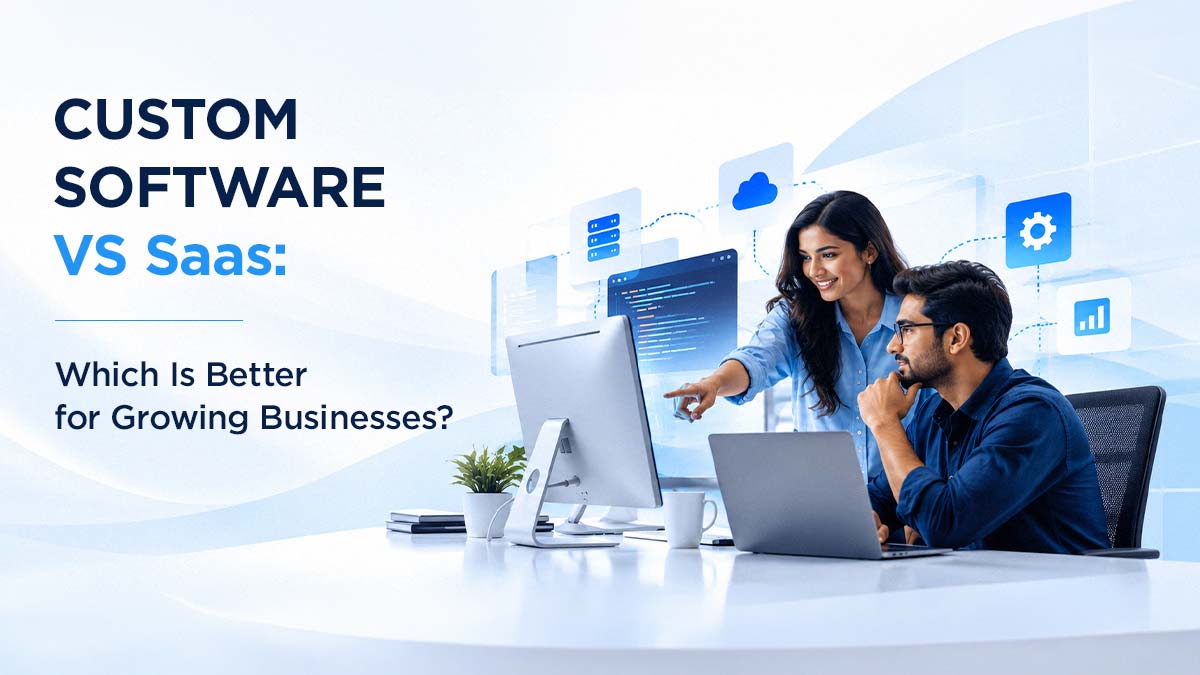
Every growing company at some point comes across a certain choice between either acquiring software for a mass market or developing software tailored to meet its unique needs. The SaaS vs. custom software dilemma is often considered a technical issue, but in reality, it is a strategic one. This will be determined by the stage of development the company has reached, the uniqueness of the processes used, how urgent it is to find a solution that works, and whether software is a key competitive advantage for the company. Making the correct choice will help move things forward fast. Making the wrong choice means wasted money and effort at times when both are scarce.
What SaaS Actually Offers and Why It Is Often the Right Starting Point
With SaaS, ready-made hosted software is available on payment of a fixed fee, thus eliminating any need for managing infrastructure, maintenance, or upgrades. This solution allows rapid deployment, and thus it is perfect for startups as well as common business processes. Being inexpensive to start and easy to use, SaaS enables teams to start working rapidly with little technological commitment. The software also gets regular updates and is scalable.
The business software solutions case for SaaS is strongest when the function being addressed is not a competitive differentiator. A company will not derive a competitive advantage from the process of paying salaries and booking meeting rooms through the software. Any off-the-shelf software package will suffice for this kind of process, which is always being refined by software vendors at a very high cost, and it will be very cheap compared to its customised version. The standard process is standard for a reason, and trying to differentiate at the operational layer where standard tools work perfectly is a poor use of development resources.
SaaS is also ideal for organisations still trying to establish their procedures since, during the formative years of a growing organisation, the process will constantly be undergoing modifications as they figure out what works and what doesn’t. Investing in custom-made software in such a situation may end up being a waste of valuable resources.
Where SaaS Starts to Fall Short as Businesses Scale
The limitations of SaaS become apparent in specific, predictable ways as businesses grow beyond the stage where standard processes are adequate. The first is configuration ceiling: every SaaS product offers a set of configurable options, but the depth of that configuration is bounded by what the vendor has chosen to make available. A business whose processes diverge significantly from the assumptions baked into a SaaS product will find itself either adapting its processes to fit the software or living with workarounds that create inefficiency at scale.
The second challenge is integration complexity. Larger companies have several cloud software applications, and connecting them together would need native integrations or middleware such as Zapier and Make, as well as custom APIs. As tools increase, this layer becomes a major source of fragility and technical debt.
The third is data ownership and portability. The software-as-a-service companies may have their own conditions for storing your data, which may not be acceptable in some situations. Therefore, it is necessary to carefully evaluate all aspects in order to avoid possible problems in the future.
The fourth, and often most significant for competitive businesses, is process differentiation. If the way a business serves its customers, manages its operations, or captures market share is genuinely different from how competitors operate, standard enterprise software development solutions designed for the average business in that category will constrain rather than enable that differentiation. A logistics company whose routing algorithm is a competitive advantage cannot replicate that advantage in a standard fleet management SaaS. An ecommerce business whose personalisation engine drives measurably better conversion cannot fully express that engine through the configuration options of a standard platform.
What Custom Business Software Solutions Actually Deliver
Software development services for growing businesses deliver, at their best, a system built precisely around how a specific organisation operates and competes, rather than how a vendor estimates an average organisation in that category operates. The implications of this difference compound over time in ways that are sometimes difficult to see clearly at the point of the initial build-versus-buy decision.
A custom system can be designed to capture and surface exactly the data points that matter to a specific business's decision-making, rather than presenting the generic reporting that a SaaS vendor has determined is relevant to most users. It can automate the specific sequences of steps that are unique to a particular business model without the manual bridges between systems that SaaS integration inevitably requires. It can evolve incrementally as the business evolves, adding capability in the specific directions the business is actually growing rather than waiting for a vendor's product roadmap to catch up with requirements.
Custom software development will also reduce the cost of per-seat SaaS licences, which can be quite costly as the number of people increases. For instance, a company paying ₹2,000 per user each month for a SaaS platform with 200 employees will be incurring ₹48 lakh yearly on the licence fees. In case a custom system was developed at ₹40 lakh and its maintenance costs ₹8-10 lakh yearly, the economics will change significantly to favour customisation without even considering the strategic advantages of custom systems.
The categories where custom development delivers the clearest business case include customer-facing applications where the product experience itself is the offering, internal operations systems where unique processes are the source of competitive efficiency and integration layers connecting multiple data sources that no standard tool adequately bridges.
SaaS vs Custom Software: A Quick Comparison
Factor | SaaS | Custom Software |
Initial cost | Lower upfront investment | Higher upfront development cost |
Implementation | Faster to set up and use | Requires planning, development and testing |
Customisation | Limited to available features and configurations | Built around specific business requirements |
Scalability | Scales within the platform's capabilities | Can be developed to support changing business needs |
Integration | Depends on available integrations and APIs. | Can be designed to connect with existing systems |
Maintenance | Updates and maintenance are generally managed by the provider. | Requires ongoing technical support and maintenance |
Long-term cost | Recurring subscription and user-based fees | Development and maintenance costs, without necessarily having per-user licence fees |
Best suited for | Standard business processes and quick deployment | Unique workflows and specialised business requirements |
The Build Process and Why It Matters as Much as the Decision Itself
The decision to build custom software is only the beginning of a set of choices that determine whether the project delivers its intended value. What usually goes wrong in custom software projects is neither a technical nor a process failure but a failure to specify software requirements precisely from the start. If a business is unable to do so, it leads to expensive, time-consuming and aimless projects where requirements are discovered through trial and error.
Software development services ensure that this is addressed through the process of taking time to plan thoroughly, by understanding business requirements, users' needs, current processes, and technical limitations, to develop a roadmap. This is the work that ensures that the actual work will meet the business requirements.
Quality assurance implemented from the development stage ensures that there is no technical debt incurred and cuts down on expenses. Software that is tested functionally, usability-wise, for performance, and for integration before being released is much more stable compared to products pushed to the market.
A Framework for Making the Decision
The build-versus-buy decision resolves most clearly when a business evaluates four specific questions honestly. First, does the process or function being addressed differentiate how the business competes, or is it generic across the industry? Generic functions belong in SaaS. Differentiated processes deserve custom consideration. Secondly, what is the actual cost of owning each option over a period of five years, taking into consideration the cost of licensing, integration work, workaround adaptation, and opportunity cost of processes hampered by software that is not suitable? Thirdly, how stable are the processes involved? Stable processes deserve to be developed, but evolving ones do not. Fourth, how long does it take to realistically implement each option before the business will need the capability?
Many businesses arrive at a hybrid answer: SaaS for the functions where standard tools work well and the process is genuinely common across organisations, custom development for the specific systems where unique processes are the source of competitive advantage. This hybrid approach is often more practically sound than a categorical commitment to either philosophy.
At ANTS Digital, our custom software development practice is built around exactly this nuanced, business-outcome-first approach. We build business software solutions across B2B and B2C customer-facing applications, internal operations systems, ERP modules, custom CRM systems, SaaS platforms, ecommerce portals, and integration layers connecting existing tools across sectors including healthcare, education, travel and hospitality, food and beverage, and social platforms. Our process begins with information gathering and planning before any design or development work begins and integrates QA engineering throughout the development cycle rather than at its conclusion and produces software designed to scale with the business rather than requiring replacement when the business outgrows its initial requirements. For growing businesses evaluating whether their current software landscape is enabling or constraining the next stage of their growth, we are happy to begin that conversation with an honest assessment of where the constraint actually lies before discussing what building something specific would involve.
Enterprise software development versus SaaS is not a question with a universal answer, and the framing of it as a binary choice obscures what is genuinely a spectrum of options from pure SaaS through hybrid integration through fully custom development. The right point on that spectrum for any specific business is determined by how distinctive its processes are, what scale of investment the economics justify, and where in the organisation software has become a genuine constraint on competitive growth. Getting this right early, rather than discovering the answer through the expensive experience of choosing wrong, is one of the more consequential technology decisions a growing business will make.
FAQs
1. How do you choose between SaaS and custom business software solutions?
Choose SaaS for standard business needs and custom software when your processes require greater flexibility or specific features.
2. When should a growing business consider enterprise software development?
When existing software cannot support its workflows, integrations, or growing operational requirements.
3. Are custom software development services more expensive than SaaS?
Custom software typically costs more upfront, while SaaS involves recurring fees that can increase as your business grows.
4. Can businesses use SaaS and custom software together?
Yes, businesses can use SaaS for everyday operations and custom software for specialised processes or integrations.

0 Comments
No comments yet — be the first to share your thoughts.
Leave a comment
Your email is never published. Comments appear after moderation.