
With each passing day, it is getting ever so difficult to capture the attention of consumers. Information is available in abundance, and everything is just whooshing past them at top speed.
To make a memorable impact on their audience, even tech companies like Google and Netflix often rely on one of the most endearing and old-school forms of advertising, out-of-home (OOH). One of the most promising and reliable methods of advertising, OOH has now widened its applications to include LED boards and, more significantly, our topic for discussion: transit advertising.
Statistics tell us that about 78% of US travellers have seen a transit advert, with about 30 million people seeing an ad on a bus every week.
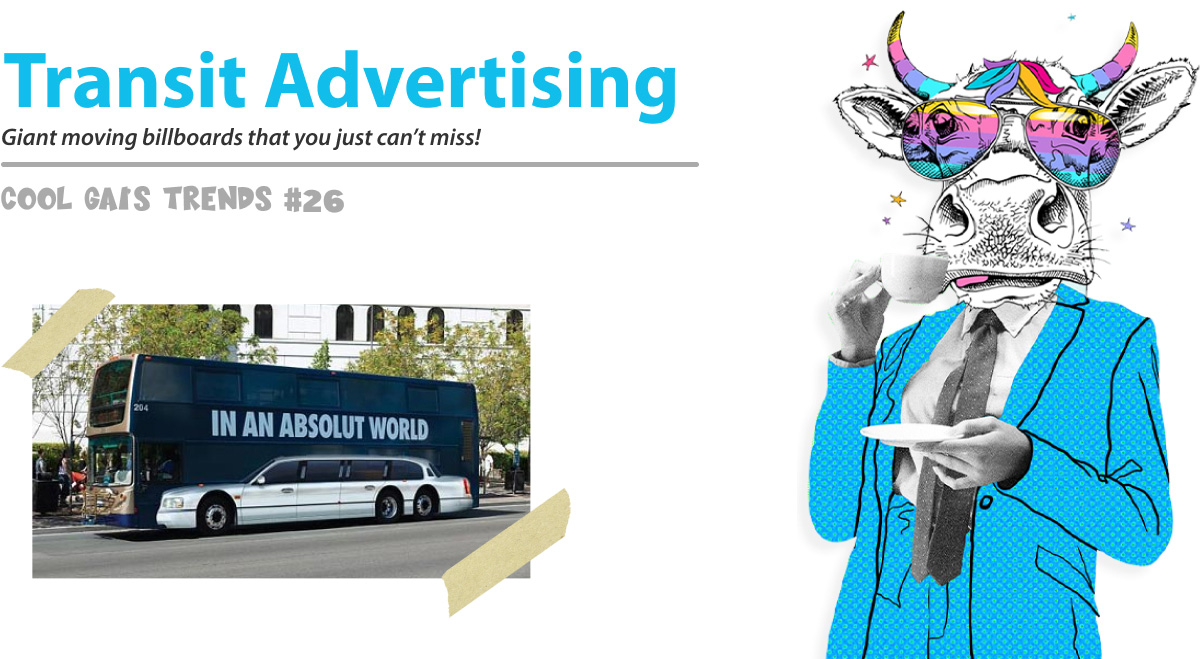
If you saw this advertisement one day, wouldn’t you be intrigued?
Of course, you will. It is absolutely clever, witty, and brilliant, and a stellar example of transit advertising.
Transit advertising refers to placing advertisements on various kinds of transport, primarily public and transportation locations like bus stops, metro stations and even metro train tunnels. The volume of commuters using the public transportation system makes them a highly lucrative location for advertising.
While OOH ads have been around, digital has offered new ways to reach consumers outside of their homes while leveraging advertising on transport and at transportation locations. With the end goal of catching the attention of potential customers, transit advertising can be in the form of simple print text and graphics, or digital ads running on a screen in a train or a bus or can be interactive (like a QR code to scan and watch the ad on their phone).

FRESH GAI EXPLORES RECENT
boAt in a Metro
Imagine you are on your way to work and taking your usual metro ride when suddenly, Manjulika (from Bhool Bhulaiya) boards the same metro from the next station. Would you run? Or just hold on to your dear life by praying she doesn’t spot you?

Well, for some people, this was not left to the imagination.
Very recently, commuters on Delhi Metro were in for a surprise (or shock?) when a woman dressed as ‘Manjulika’ actually boarded their metro. As the commuters, some scared, some amused, were trying to figure out the scenario, another guy dressed as a player from ‘Squid Game’ came running inside the metro. In the third instance, another guy dressed as a ‘Money Heist’ character boarded with some bags.
It all turned out to be a marketing campaign by the brand to drive the message that their products make the streaming experience so powerful that the characters come to life!

BRAINY GAI SHOWS US THE EVOLUTION OF 
From horse to horsepower
Up until the early 19th century, local stores advertised themselves on the sides of the horse-driven carts to publicise themselves across cities.
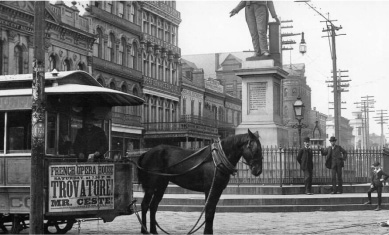
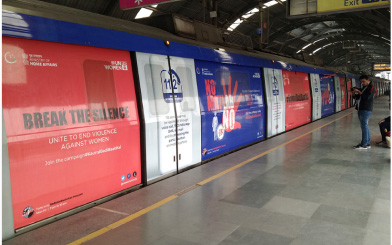
Transit advertising has come a long way since then. Various advertisements can be spotted on local trains, buses, aeroplanes and even cars. In Delhi, it is common to see a metro covered in dedicated brand advertisements.
The Delhi metro is estimated to have an annual ridership of 80 crores, with a daily ridership of 29 lakhs. Imagine the reach of the advertisements!
WHY DOES TRANSIT ADVERTISING WORK?
The benefits of transit advertising:
- You find your audience everywhere, offering unparalleled exposure with a higher frequency.
- Compared to the number of potential customers it reaches, transit ads are extremely cost-efficient.
- It is mobile and flexible. Transit ads have the potential to reach an entire city, country and sometimes even the world. And that too, without repeated costs!
- It’s versatile and can be displayed in many forms, including cars, buses or trains wrapped in advertisements. These are referred to as exterior transit advertising.
- Interior transit ads, referring to posters, boards, leaflets and audio-video ads on screens, can also be leveraged to get the desired attention.
- Unlike a TV ad or social media ad, the viewer can neither skip or forward the ad, nor switch the device off. This increases the exposure of the audience to the ad, thereby making them obviously noticeable.
QUIRKY GAI SHOW US THE MOST INTERESTING 
High in the sky...
Sometimes branding is so interesting and creatively done that it makes you laugh! 
DHL was the logistics partner for Amazon’s hit car show, The Grand Tour. To promote the show, DHL started a competition for fans to name three of their planes. And the fans didn’t disappoint as the names they came up with guaranteed laughs and made everyone want to watch the show.
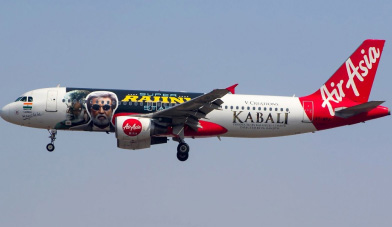
Superstars like Rajinikanth deserve more than just regular advertising. A superstar deserves his work to be showcased on the next level. To achieve this, AirAsia India turned one of their A320s into a movie poster to promote Kabali. AirAsia even served kuzhi panniyaaram on board, which is our Thalaivar’s favourite dish.
… and on the ground!
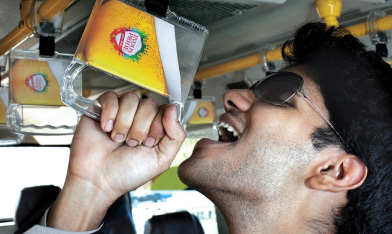
Indus Pride’s campaign titled ‘Beer Mug’ popularised their non-alcoholic beer by branding the handles in the airline transit buses.
The primary goal of any kind of advertising is to get the attention of as many people as possible. However, a big banner in one area of a city will have limited impact, transit advertising gives us a solution to this issue, by making the advertisement mobile it can reach far more people and have a much larger impact and create dynamic brand recognition.
How did this land?
0 reactions
Cool Gai
Latest Trends
-
 #Trend 71
Take a look back on the successful year we had at Ants Digital
25th December 2024
#Trend 71
Take a look back on the successful year we had at Ants Digital
25th December 2024
-
 #Trend 70
Is Air Pollution during Diwali campaign worthy? Cool Gai investigate...
30th October 2024
#Trend 70
Is Air Pollution during Diwali campaign worthy? Cool Gai investigate...
30th October 2024
-
 #Trend 69
Take a trip down the feel-good memory lane with Cool Gai!
16th October 2024
#Trend 69
Take a trip down the feel-good memory lane with Cool Gai!
16th October 2024
-
 #Trend 68
Ants Digital has won big! Know all about our winning campaigns with...
2nd October 2024
#Trend 68
Ants Digital has won big! Know all about our winning campaigns with...
2nd October 2024
-
 #Trend 67
Cool Gai shows sometimes the greater good is better than one-upmansh...
18th September 2024
#Trend 67
Cool Gai shows sometimes the greater good is better than one-upmansh...
18th September 2024
-
 #Trend 66
What is the difference in communication between two brands that sell...
3rd September 2024
#Trend 66
What is the difference in communication between two brands that sell...
3rd September 2024
0 Comments
No comments yet — be the first to say something.
Leave a reply
Your email is never published. Comments appear after moderation.